
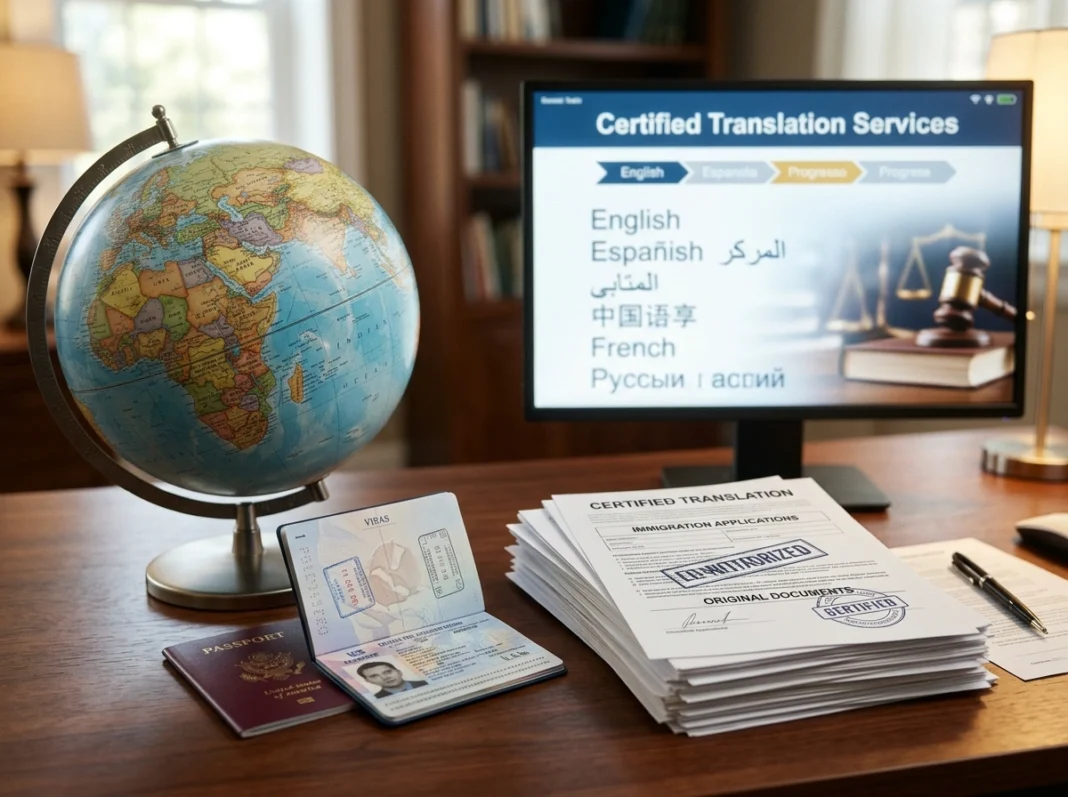

Moving to a new country involves countless forms, extensive background checks, and strict deadlines. Applicants spend hours gathering personal records from their home countries to prove their identity, legal status, and personal history. During this complex procedure, a single misunderstood document can derail months of hard work. Language barriers present a significant obstacle, as government agencies require all foreign language documents to be presented in their official language.
To bridge this gap, immigration authorities mandate strict translation protocols. Submitting a basic, unofficial translation is a common mistake that leads to automatic rejections or frustrating delays. Government officials need absolute certainty that the English version of a document matches the original source text perfectly. They rely on standardized certification processes to verify authenticity and maintain the integrity of the immigration system.
Understanding how to properly prepare your foreign language documents is a vital step toward a successful application. Proper preparation removes uncertainty and gives immigration officers exactly what they need to approve your case. By utilizing professional certified translation services, applicants can safeguard their immigration journey, save valuable time, and avoid unnecessary legal complications.
What are certified translation services?
A certified translation is a formally verified document completed by a professional translator. It includes a signed statement, often called a Certificate of Accuracy, which affirms that the translated text is a true and accurate representation of the original document. This signed statement is what separates a certified document from a standard translation.
Translators who provide these services are highly skilled professionals. They understand complex legal terminology in multiple languages and follow strict formatting guidelines. The certification statement typically includes the translator’s credentials, contact information, date of translation, and a formal declaration of competence.
Many government bodies require this specific level of certification to prevent fraud. They cannot verify the skills of a bilingual family member or friend, so they reject unofficial translations. Relying on professional services guarantees that your documents meet the rigorous standards expected by national immigration authorities.
Legal requirements for immigration documents
Immigration authorities, such as the United States Citizenship and Immigration Services (USCIS), operate under specific legal frameworks regarding foreign documents. According to the Code of Federal Regulations, any document containing foreign text submitted to USCIS must be accompanied by a full English translation.
The translator must certify that the translation is complete and exact. They must also certify that they are competent to translate from the foreign language into English. Failing to include this signed certification results in immediate complications. The agency will issue a Request for Evidence (RFE), halting the processing of your application until the correct paperwork is provided.
Some specific situations also require notarized translations. While USCIS generally accepts standard certified translations, local courts, embassies, or professional licensing boards might demand a notarized signature. This means a Notary Public must witness the translator signing the Certificate of Accuracy. Understanding the precise legal requirements of the specific agency reviewing your case is essential for a smooth process.
The crucial role of accuracy in preventing delays
Accuracy in immigration translation means much more than just swapping words from one language to another. Legal and governmental documents contain highly specific terminology, cultural nuances, and localized formatting that do not always have direct English equivalents. A professional translator knows how to handle these discrepancies without altering the document’s original meaning.
Small errors carry massive consequences. A misspelled name, an incorrect date format, or a mistranslated legal term can trigger a fraud investigation. For example, if a standard civil title is translated improperly, an immigration officer might believe the applicant is lying about their marital status or criminal history.
These discrepancies lead to lengthy delays. An RFE adds weeks or even months to the application timeline. If the translation errors are severe enough, the application can be outright denied, forcing the applicant to pay filing fees again and restart the entire process. Accuracy protects the applicant’s investment of time and money.
How professional translations help immigration officers
Immigration officers review hundreds of applications every week. Their job is to verify facts quickly and enforce federal laws. When they open an application file, they look for clarity, organization, and compliance with government standards.
Certified translations make an officer’s job significantly easier. Professional agencies format the translated document to mirror the original file. If a birth certificate has a specific table or seal in the top right corner, the translation will replicate that layout. This allows the reviewing officer to compare the original document and the English translation side-by-side without confusion.
Providing high-quality, clearly formatted documents builds immediate trust. When an officer sees a professional Certificate of Accuracy, they can confidently check off that requirement and move on to the next phase of the review. Minimizing the friction an officer experiences directly improves the efficiency of your case processing.
Common documents requiring certified translation
Most family-based and employment-based immigration petitions require a standard set of vital records. Any document not originally issued in English must go through the certification process.
Birth certificates
Birth certificates prove an applicant’s identity, age, and parentage. They are fundamental for almost every type of visa or residency application. Translators must pay close attention to the names of issuing municipalities, parental titles, and local registry stamps.
Marriage licenses and divorce decrees
For spousal visas or family petitions, proving the legal validity of a marriage is mandatory. Marriage certificates and divorce decrees contain complex legal jargon regarding jurisdiction and civil codes. Accurate translation ensures the immigration department recognizes the current legal status of the applicant.
Police records and background checks
Immigration agencies conduct thorough background checks to ensure applicants do not pose a security risk. Police clearance certificates from foreign countries must be translated precisely. Any mistranslation of penal codes or clearance statuses can incorrectly flag an applicant for a criminal history.
Academic transcripts and diplomas
Employment-based visas, such as the H-1B, often require proof of educational qualifications. Translating academic transcripts involves converting foreign grading systems and specialized degree titles into terms that U.S. officials and credential evaluators can understand.
Financial and medical records
Applicants must often prove they can financially support themselves or that they meet specific health requirements. Bank statements, tax returns, and vaccination records frequently require certified translation to meet sponsorship and public health guidelines.
Frequently asked questions about immigration translation
Can I translate my own documents for USCIS?
No. Even if you are completely fluent in both languages, immigration authorities do not allow applicants to translate their own documents. The translation must be completed by a neutral, competent third party to prevent bias and fraud.
Do certified translations expire?
Generally, a certified translation does not expire as long as the original document remains valid. A translation of a birth certificate will remain valid indefinitely, whereas a translation of a recent bank statement is only relevant for the specific application timeline.
Does a translation need to be done by an ATA member?
While using a translator affiliated with the American Translators Association (ATA) ensures high quality and is highly recommended, USCIS does not strictly require the translator to be an ATA member. The strict requirement is the signed Certificate of Accuracy demonstrating competence.
Taking the next step toward a successful application
Securing your future in a new country requires careful attention to detail. The paperwork can feel overwhelming, but utilizing the right resources makes the journey manageable. Certified translations are an essential component of this process, providing the legal clarity and professional formatting that government agencies demand.
By partnering with experienced language professionals, you eliminate the risk of translation-based rejections. You provide immigration officers with the clear, accurate information they need to approve your case promptly. Before submitting your final application packet, review your checklist carefully, identify every foreign document, and secure your certified translations to ensure your application stands the best possible chance of success.