
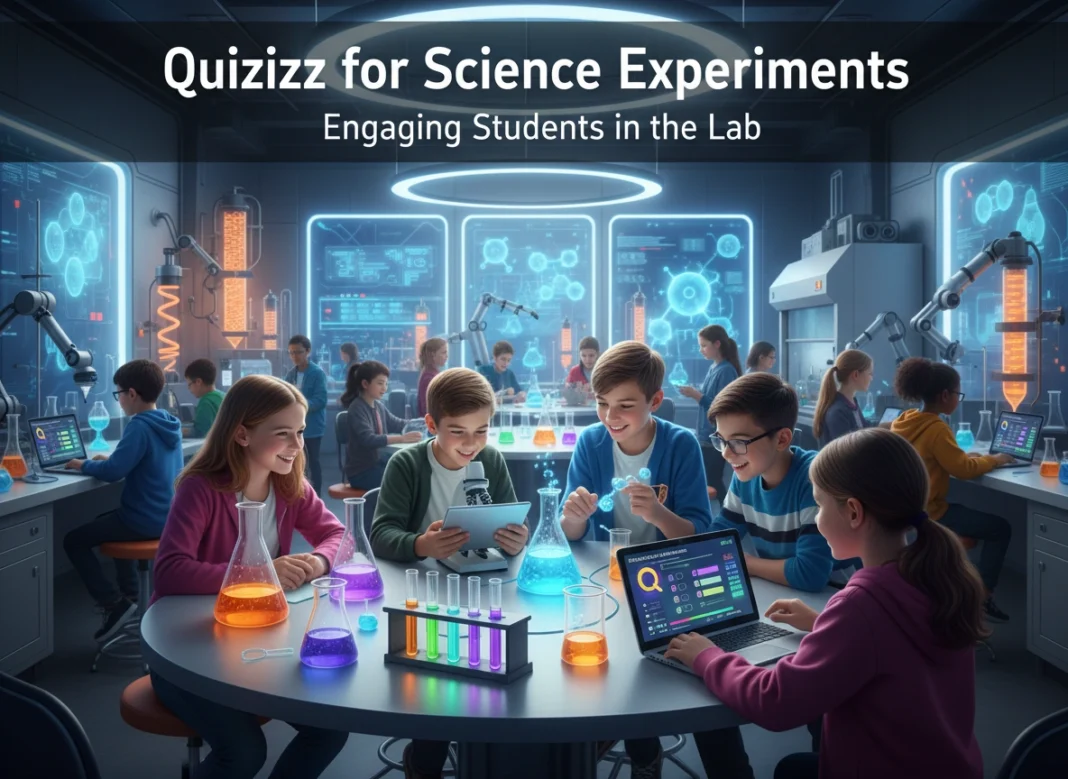

Science education stands on the brink of a digital transformation. The days of silent labs where students simply follow a cookbook recipe for experiments are fading. Today’s students crave interaction, immediate feedback, and a sense of progress.
This article explores how Quizizz, a popular interactive learning platform, can be the missing link between theoretical knowledge and practical application in the science lab. We will discuss the tangible benefits of gamification, the power of real-time data, and provide concrete strategies for integrating this tool into your science curriculum.
The Challenge of Engagement in Modern Science Labs
Science labs are traditionally the most exciting part of a science curriculum. They offer hands-on experiences where chemical reactions bubble, physics principles come to life, and biology reveals its microscopic secrets. However, educators often face a disconnect.
Students may perform the motions of an experiment without truly understanding the “why” behind their actions. They might follow instructions perfectly but fail to grasp the underlying scientific concepts. Furthermore, the logistical chaos of managing equipment and safety can leave little room for checking individual understanding during the lab itself.
Teachers need a way to bridge the gap between “doing” and “learning.” This is where digital tools like Quizizz offer a powerful solution. By integrating interactive assessment directly into the laboratory environment, we can transform passive observation into active inquiry.
Why Quizizz Works for Science Education
Quizizz is often associated with vocabulary drills or history reviews, but its application in the science lab is profound. The platform’s features align perfectly with the needs of inquiry-based learning.
Instant Feedback Loops
In a traditional lab, a student might hand in a report a week after the experiment. By the time they receive feedback, the moment of learning has passed.
With Quizizz, feedback is immediate. If a student answers a pre-lab safety question incorrect, they know instantly. This allows for on-the-spot correction before they handle dangerous chemicals or expensive equipment. This immediacy cements the correct information while the context is fresh.
Gamification Driving Motivation
Science can be intimidating. Complex formulas and abstract concepts often discourage students before they even begin. Quizizz leverages gamification elements—points, leaderboards, and avatars—to lower the stakes and increase engagement.
When a formative assessment feels like a game, anxiety drops. Students become more willing to take risks and guess answers based on their observations. This shift from “testing” to “playing” creates a psychological safety net that encourages curiosity.
Data-Driven Instruction
For the educator, the real power lies in the dashboard. While students are running an experiment, a teacher can launch a quick “checkpoint” quiz. The live results show exactly which groups are grasping the concept and which are struggling.
Instead of waiting for the final lab report to discover that half the class misunderstood the hypothesis, you can intervene immediately. You can pause the class, reteach a specific concept based on the data, and then let them proceed.
Practical Strategies: Integrating Quizizz into the Lab Workflow
Integrating technology into a wet lab requires careful planning. You don’t want tablets near open flames or water. However, with strategic implementation, Quizizz can enhance every phase of the experiment lifecycle.
1. The Pre-Lab Ticket
Before students ever touch a beaker, they need to understand the safety protocols and the objective of the day.
Strategy: Create a short, 5-question Quizizz as an “entry ticket.”
- Content: Cover key safety hazards (e.g., “What do you do if acid spills?”), equipment identification, and the central hypothesis.
- Implementation: Students must score 100% to receive their equipment.
- Benefit: This ensures that every student entering the practical phase is prepared and safety-conscious. It places the responsibility of preparation on the student.
2. The Mid-Lab Checkpoint
Long experiments often have downtime. While a solution is heating or a sample is incubating, students often disengage or distract each other.
Strategy: Use “Instructor-Paced” mode for a synchronized check-in.
- Content: Ask questions related to their current observations. “Based on the color change you just saw, is the solution acidic or basic?”
- Implementation: Project the questions on the main screen. Have groups discuss the answer before submitting one response per team.
- Benefit: This keeps students focused on the science during downtime. It fosters collaboration as they debate the correct answer based on their live data.
3. The Post-Lab Analysis
The post-lab discussion is where the synthesis happens. This is where data becomes knowledge.
Strategy: Run a competitive “Exit Game” to review findings.
- Content: Focus on data interpretation. Display a graph or a set of results similar to what they generated and ask them to draw a conclusion.
- Implementation: Allow students to play individually to check their personal understanding.
- Benefit: This serves as a formative assessment to gauge how well the class achieved the learning objectives. It replaces the often-dreaded “exit slip” with something energetic.
Enhancing Collaboration and Scientific Discourse
One of the most significant impacts of using Quizizz in the lab is the boost in collaboration. Science is rarely a solitary endeavor; it requires peer review and discussion.
By using the “Team Mode” in Quizizz, you turn assessment into a group activity. When a question pops up regarding the experiment, students must talk to each other. They have to articulate their reasoning.
“I think it’s exothermic because the beaker got hot,” one student might argue.
“But look at the graph on the screen,” another might counter.
This dialogue is the heart of scientific inquiry. It moves students away from rote memorization and toward critical thinking. The app becomes merely the prompt for the rich human interaction happening at the lab bench.
Addressing Diverse Learning Needs
Science classrooms are diverse, containing students with varying levels of background knowledge and language proficiency. Quizizz offers features that make science more accessible.
- Read Aloud: For students with reading difficulties, the audio options ensure they aren’t penalized for literacy barriers when testing scientific knowledge.
- Visual Integration: Science is visual. You can embed images of diagrams, chemical structures, or biological specimens directly into the questions. This helps visual learners connect the abstract term to the physical reality they see in the lab.
- Self-Paced Options: In “Homework” or “Async” mode, students who process information slower can take their time answering post-lab analysis questions without the pressure of a timer.
Case Study Example: The Photosynthesis Lab
To visualize this in action, let’s look at a standard high school biology lab: Testing photosynthesis rates using aquatic plants.
Traditional Approach:
The teacher lectures on photosynthesis. Students place plants in water, count bubbles, and write a report. Many students count bubbles without understanding they represent oxygen.
The Quizizz Enhanced Approach:
- Pre-Lab: Students complete a Quizizz on the chemical equation of photosynthesis. They identify the reactants and products.
- During Lab: As they set up the light sources, a live poll asks: “If we move the light closer, what do you predict will happen to the bubble rate?” This forces them to construct a hypothesis immediately.
- Data Collection: Halfway through, the teacher pauses for a “Data Check.” A question asks, “What gas is inside the bubbles you are counting?” (Options: Carbon Dioxide, Oxygen, Nitrogen). The teacher sees 40% of the class chose Carbon Dioxide.
- Intervention: The teacher pauses the lab. They clarify that the plant is producing oxygen, not consuming it. The misconception is corrected instantly.
- Conclusion: The lab ends with a leaderboard showing which teams successfully predicted the outcome based on their data.
Implementation Tips for Administrators and Teachers
Adopting new technology requires buy-in and infrastructure. Here are steps to ensure success:
For Administrators:
- Device Access: Ensure labs have access to sturdy cases for tablets or dedicated “clean zones” for laptops.
- Professional Development: Provide training not just on how to use the software, but on how to write good questions that test higher-order thinking, not just recall.
For Teachers:
- Start Small: Don’t try to gamify an entire 90-minute lab immediately. Start with a simple exit ticket.
- Focus on the “Why”: Ensure your questions probe the reasoning behind the experiment, not just the procedure.
- Celebrate Mistakes: Use the data visualization to show common wrong answers. Discussing why a distractor answer is wrong is often more valuable than simply knowing the right answer.
Conclusion
Quizizz is more than a colorful quiz tool; it is a catalyst for engagement in the science laboratory. By integrating it into experimental workflows, educators can ensure that students are mentally “turned on” while their hands are busy.
It provides the real-time data teachers need to be effective facilitators. It gives students the immediate feedback they need to feel confident. Most importantly, it makes the rigorous work of scientific inquiry accessible, collaborative, and fun.
As we strive to create the next generation of scientists and critical thinkers, tools that blend digital engagement with physical experimentation will be essential. It is time to bring the device out of the pocket and onto the lab bench—safely, effectively, and purposefully.
Please click here for more info