
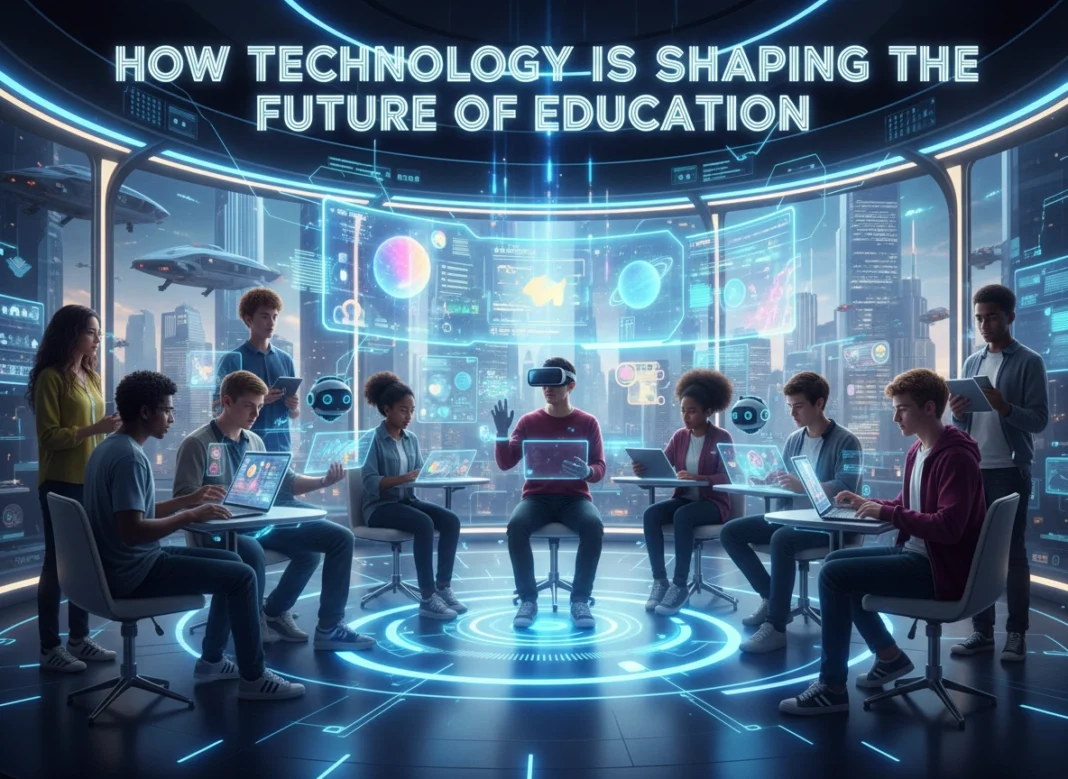

The traditional classroom model, with its rows of desks and a teacher at the front, has remained largely unchanged for centuries. However, a powerful current of change is now reshaping this landscape. Technology is not just an add-on; it is fundamentally altering how students learn, how teachers instruct, and how educational institutions operate. From artificial intelligence to virtual reality, digital tools are unlocking new possibilities for a more personalized, accessible, and engaging educational future.
This article will explore the key technological trends defining the next era of education. We will examine the integration of AI in classrooms, the continued rise of online learning, the power of personalized learning paths, the immersive potential of VR and AR, and how technology is breaking down barriers to create a more inclusive learning environment for everyone.
The Rise of AI in the Classroom
Artificial intelligence (AI) is moving beyond the realm of science fiction and into practical classroom applications. Its primary role is not to replace teachers, but to augment their capabilities and automate administrative burdens. This allows educators to focus on what they do best: inspiring and mentoring students.
AI-Powered Tutoring and Support
One of the most significant impacts of AI is its ability to provide personalized support to students. Intelligent tutoring systems can adapt to a student’s individual learning pace, offering extra practice on difficult concepts or presenting new challenges to those who have mastered a topic. For example, platforms like Khan Academy use AI to generate practice questions and provide instant feedback, helping students identify their weak points and work on them independently. This frees up teacher time for more complex, high-level instruction and one-on-one support.
Automating Administrative Tasks
Teachers often spend a significant portion of their day on non-teaching activities, such as grading, lesson planning, and managing records. AI tools are increasingly being used to automate these repetitive tasks. Automated grading systems can quickly assess multiple-choice and fill-in-the-blank assignments, providing immediate results to both students and teachers. AI can also help educators curate learning materials, suggesting relevant articles, videos, and interactive content based on the curriculum. This efficiency allows teachers to dedicate more energy to student interaction and creative lesson design.
The Expansion of Online Learning Platforms
The global shift toward remote learning accelerated the adoption of online educational platforms, and their influence continues to grow. These platforms offer flexibility and access to a vast array of courses that might not be available locally. Websites like Coursera, edX, and Udemy have partnered with top universities and industry experts to offer everything from individual courses to full degree programs online.
This model benefits not only traditional students but also lifelong learners seeking to upskill or change careers. A professional in marketing can take a course in data analytics, or a retiree can study art history from a world-renowned museum, all from the comfort of their home. The flexibility of asynchronous learning, where students can access materials at any time, makes education more compatible with the demands of modern life. This democratizes access to high-quality education, removing geographical and time-based constraints.
Crafting Personalized Learning Experiences
The one-size-fits-all approach to education is becoming a thing of the past. Technology enables the creation of personalized learning paths that cater to each student’s unique strengths, weaknesses, interests, and learning style.
Adaptive Learning Technology
Adaptive learning platforms use algorithms to adjust the educational content in real-time based on a student’s performance. If a student is struggling with a particular math concept, the system can provide foundational videos and simpler problems to help build their understanding. Conversely, if a student demonstrates mastery, the system can introduce more advanced topics to keep them challenged and engaged. This dynamic approach ensures that students are always learning at the optimal level of difficulty, which boosts both confidence and retention.
Data-Driven Insights for Educators
Technology also provides teachers with a wealth of data about student performance. Learning management systems (LMS) can track how long students spend on certain topics, which questions they struggle with, and where they excel. Educators can use these analytics to identify at-risk students who may need extra help and to understand which parts of their curriculum are most effective. This data-driven approach allows for early intervention and a more targeted, evidence-based teaching strategy.
Immersive Learning with VR and AR
Virtual Reality (VR) and Augmented Reality (AR) are transforming learning from a passive activity into an active, immersive experience. These technologies can transport students to places and situations that would be impossible or impractical to visit in real life.
Virtual Field Trips and Simulations
Imagine a history class where students don’t just read about ancient Rome but walk through a virtual reconstruction of the Colosseum. Or a biology class where students can manipulate a 3D model of a human heart to understand how it functions. VR makes this possible. Medical students are already using VR simulations to practice complex surgical procedures in a risk-free environment. These experiences create memorable and impactful learning moments that go far beyond what a textbook can offer.
Augmented Reality in the Classroom
AR, which overlays digital information onto the real world, also has powerful educational applications. Using a smartphone or tablet, a student could point their device at a diagram in a science book and see a 3D animation pop up on their screen. In an art class, AR apps can provide information about a painting as a student views it. This technology adds a rich, interactive layer to physical learning materials, making them more engaging and informative.
Enhancing Accessibility and Inclusivity
Perhaps one of the most important contributions of technology to education is its potential to make learning more accessible and inclusive for students with diverse needs. Digital tools can help level the playing field for students with physical, sensory, or learning disabilities.
Text-to-speech software can read digital textbooks aloud for students with visual impairments or dyslexia. Speech-to-text tools allow students who have difficulty writing to dictate their essays and assignments. For students on the autism spectrum, educational apps can provide a structured and predictable learning environment. Furthermore, online learning platforms offer a lifeline for students who are unable to attend a physical school due to health issues or geographic isolation. By providing alternative ways to access and engage with content, technology ensures that every student has the opportunity to succeed.
Conclusion: A Collaborative Future
Technology is not a silver bullet for the challenges facing education, but it is an incredibly powerful tool. Its successful integration depends on thoughtful implementation, proper teacher training, and a focus on pedagogy over gadgets. The future of education is not one where technology replaces human connection, but one where it enhances it. By handling routine tasks and providing personalized support, technology frees up educators to focus on fostering critical thinking, creativity, and collaboration—skills that will be essential for the next generation. As these tools continue to evolve, they will undoubtedly open up even more exciting possibilities for a smarter, more equitable, and more engaging world of learning.
Please visit this website for more info